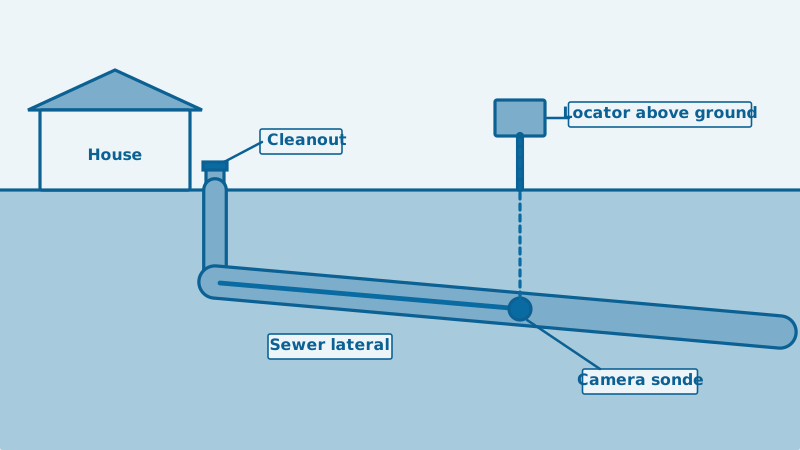
This is mostly a shopping question, so here is the plain answer first. A sewer camera with a locator is a camera on a flexible rod with a small transmitter behind the lens, plus a handheld receiver that finds the transmitter from above ground. Buying makes sense for a plumber who uses it weekly. For a homeowner with one backup to diagnose, hiring a sewer camera inspection usually costs less than a decent camera, and the person doing it reads the picture for you.
What does a sewer camera with a locator actually do?
The camera shows the inside of the pipe. The locator, a receiver you carry over the ground, picks up a radio signal from a small transmitter called a sonde, built into the camera head or the rod behind it. When you stand directly over the sonde, the receiver shows the point and an approximate depth, so you know exactly where to dig or repair.
Without a locator, the video says "a break at 43 feet" and nothing about where that is in the yard. With one, you mark the spot on the surface and measure the depth. Many push cameras use a sonde that transmits at 512 Hz, and the locator must be tuned to the same frequency.
Vendors claim accuracy within a few inches of position and about 10 percent of depth, though those are manufacturer figures, and soil, rebar and nearby metal affect the reading. Read depth as a guide and confirm before a trench is opened.
What should I look for in the best sewer camera with a locator?
Look first at what pipe you have: a 4 inch lateral to the street needs a camera head and rod long enough to reach the city main from your cleanout and flexible enough to turn bends. Then check that the locator and sonde match, that the head is self leveling if you want the picture to stay upright, that the recording saves to a card, and that the battery lasts a full job.
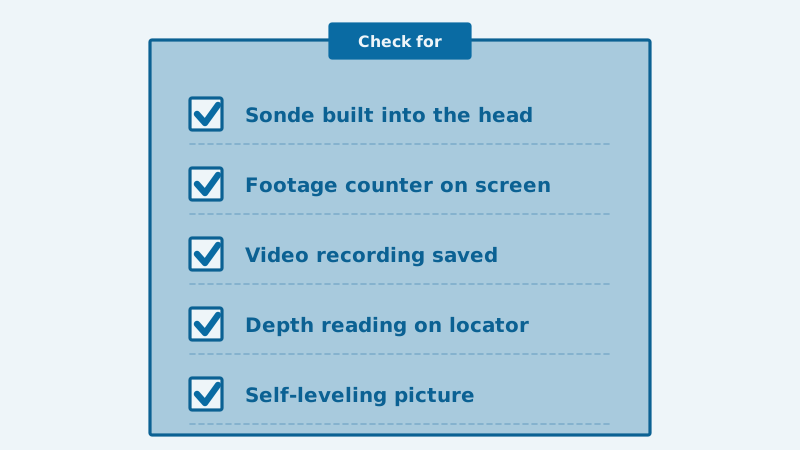
A short checklist:
- Rod length and stiffness. Too short and it never reaches the main. Too soft and it coils at the first bend.
- Head size. A small head gets through a trap or cleanout. A larger head gives a better picture in a big pipe.
- Self leveling head. The picture stays upright as the head rolls. It is the feature people mean by "self-leveling sewer camera with locator". See self leveling sewer camera with locator for the features.
- Sonde and locator. The frequency must match. Check that the receiver reads depth and signal strength.
- Recording. A camera that cannot record is of little use as evidence.
- Footage counter. It tells you how far in the break is.
We do not rank brands here. A table of features is more useful than a name, because models change every season, and a camera that suits a plumber does not suit a homeowner. Read the manual and the reviews of verified buyers before you buy.
Is it worth buying one or hiring the inspection?
For most homeowners, hiring is the better deal. National price guides put a camera inspection at roughly $125 to $750, depending on length and whether the locating is included, which is often less than the cost of a camera that finds a break reliably. Buy only if you will use it repeatedly, such as on a rental portfolio or a property you manage.
Buying brings costs you do not see in the listing: learning the rod, reading the picture, a second person to hold the locator, and the risk of pushing a camera into a fragile pipe. A person who looks at pipes weekly knows a root from a joint and a belly from a shadow.
Los Angeles has a Sewer Lateral CCTV Rebate from LA Sanitation, for camera inspections of private laterals done by a bonded sewer contractor who holds the required license. Check the current rules on the city's page before you book, because terms change. A DIY camera does not qualify.
What does a sewer camera inspection show in a Los Angeles lateral?
It shows the pipe material, joints, cracks, offsets, roots, grease, sagging sections and the connection to the city main. In older neighborhoods that often means clay with root intrusion at the joints, cast iron scale, or in some homes built from the 1940s to the early 1970s, Orangeburg, a tar and wood pulp pipe that softens with age.
A good recording is a record you can keep. You will see a counter, so each defect has a distance, and the locator gives the surface mark. That lets you compare quotes for the same defect rather than guess. It also shows whether the problem is on your side of the property line: LA Sanitation says owners maintain the private lateral, up to the city main.
A tree root picture needs context: fine roots at a joint can be cut and managed, while roots with a collapsed section call for repair. Our guide to the signs of tree roots in a sewer line helps you read what the camera shows.
Can a sewer camera go down the toilet?
Sometimes. Some small cameras can go in through a toilet flange once the toilet is pulled, which gives access when there is no cleanout. Pushing a camera through the bowl and its trap is often impractical, so the toilet usually comes off first. A cleanout is the preferred route, and pulling a toilet means resetting it with a new wax ring.
If you have no cleanout, ask about one. A cleanout installed near the house makes every later cleaning and camera visit simpler.
What does it cost to hire a camera with a locator?
National guides put camera inspection at roughly $125 to $750, and West Coast prices tend to run above that. Locating, a longer lateral, a written report and a recording on a drive raise the figure. The written quote after a visit is the real price. See camera drain inspection cost and camera sewer line inspection cost for more.
You can send a quote request, and we arrange a local drain cleaner who gives a written price before work starts. Nothing is done until you agree. For related services, see sewer camera service and the LA Drain Works home page.
Questions people ask
What is the worst thing a home inspector can find?
On the sewer side, a collapsed or severely cracked lateral is among the costliest findings, because repair can mean excavation or lining. A camera inspection before a purchase shows pipe condition and gives you a basis for negotiating. A home inspector's general report often leaves the lateral out unless a camera is used.
How deep can a sewer locator find the camera?
It depends on the model. Portable units often list a typical maximum around five to eight feet, but soil, nearby metal and signal strength change that. A locator shows depth as an approximation, so treat it as a guide and verify before digging.
Do I need a locator if I only want to see the pipe?
No. A camera without a locator shows the inside of the pipe. You need the locator when you must know where a defect is on the surface, for example before a spot repair or when a pipe runs under a driveway.
Can I rent a sewer camera?
Some rental yards offer one. You get the rod and screen, and sometimes a locator. The skill is in reading the picture and not pushing past a defect, so many people find a hired inspection easier. If you rent, ask for a lesson and a locator.
How often should a lateral be inspected?
There is no fixed schedule. A camera look is sensible when you buy a home, after a backup, or when roots are a known issue. For a root-prone line, a look after each cleaning shows whether it is returning. See sewer scope inspection for the home purchase version.
Guides in this section
- Camera inspection cost
A camera drain inspection in Los Angeles costs about $150 to $400.
- Self-leveling sewer camera
How a self-leveling sewer camera keeps the picture upright, what the sonde and locator do, the specs that matter and what roots look like…
- Sewer camera inspection
A sewer camera inspection shows what is inside your line.
- Sewer pipe inspection camera
Hiring a sewer pipe inspection camera service in Los Angeles: what the visit involves, what you get on video and paper, what to ask first…
- Sewer scope inspection
A sewer scope inspection before you buy a house shows the condition of the lateral the home inspector skips.
Sources used
- LA Sanitation, Sewer Lateral CCTV Rebate
- LA Sanitation, managing and protecting LA's underground sewer system
- HomeGuide, hydro jetting cost (2026), camera inspection range
- Manufacturer descriptions of 512 Hz sonde locators, read November 2026
- Published 2026 price guides for sewer camera inspection, checked November 2026
Page updated