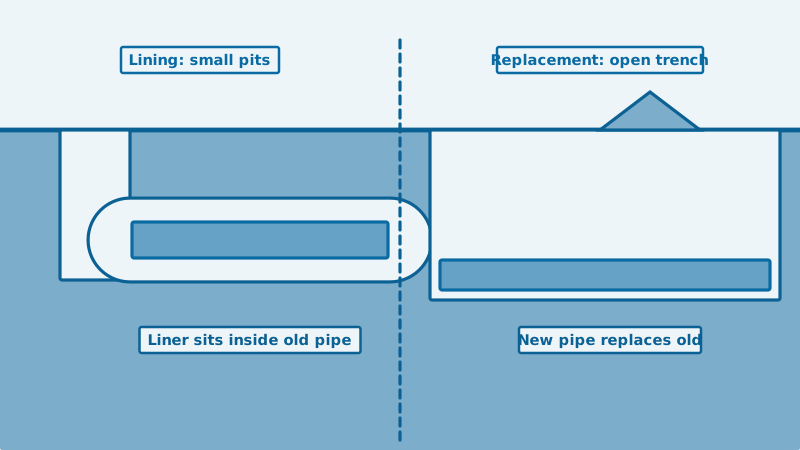
Lining is the better choice when the pipe is still round, connected and structurally sound enough to carry a resin sleeve. Replacement is better when the pipe has collapsed, sagged, is Orangeburg, or has been patched many times. For a 50-foot Southern California lateral, published ranges are about $4,800 to $7,200 for lining and $6,000 to $13,000 for bursting or open trench.
This page is a decision guide. For how each method works, read no dig sewer line repair. The rest of our services are on the LA Drain Works home page.
What is the real difference between lining and replacing a sewer pipe?
Lining leaves the old pipe in the ground and puts a new resin pipe inside it. Replacement removes or breaks up the old pipe and installs a new one, either in an open trench or by pulling it through the old route. Lining shrinks the bore a little. Replacement can restore or enlarge it.
| Lining | Replacement (trench or burst) | |
|---|---|---|
| Old pipe | Stays in place | Removed or broken up |
| New pipe | Resin sleeve inside the old pipe | New plastic pipe |
| Digging | Small access pits | Trench, or two pits for bursting |
| Fixes a sag or belly | No | Yes, with new grade |
| Disruption | Lowest | Highest in a trench |
Lining and bursting both count as trenchless sewer repair, because they avoid a long trench. Open-trench replacement does not. If you hear "trenchless sewer line" work quoted, ask which of the two it is.
Which one fits my pipe material?
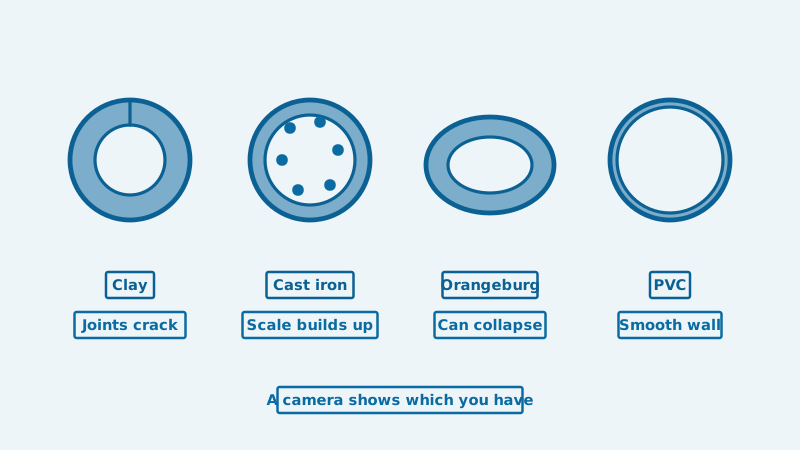
Clay and cast iron with cracks, root entry or open joints are good lining candidates if they are still round. Orangeburg usually calls for replacement, because it deforms and does not hold a liner well. Pipe with a belly, offset joints or collapse needs replacement or a spot dig, because a liner copies the old shape.
Rule of thumb by material:
- Vitrified clay: cracked or root-invaded, still aligned: lining works well. Broken and shifted: dig that section.
- Cast iron: thinned from corrosion but round: lining can work. Flaking badly: replace.
- Orangeburg fiber: replace by bursting or trench.
- Plastic (PVC or ABS): usually newer, so repair the specific defect.
In Los Angeles, many older homes have clay or cast iron laterals, and some mid-century homes have Orangeburg. A camera tells you which one you have, and that decides most of the question.
Which one costs less?
Per foot, lining often costs more than digging, but the whole job can cost less once concrete, landscaping and driveway repair are counted. Published California ranges are about $80 to $250 per foot for lining, $60 to $250 for bursting and $50 to $250 for open trench before restoration. These are guides, not quotes.
Worked example from a Southern California contractor's published figures for 50 feet: lining about $4,800 to $7,200, open cut with restoration about $6,100 to $12,400, bursting about $6,000 to $13,000. Another way to say it: on a clear lawn with shallow pipe, a trench can cost the least. Under a patio, a mature tree or a slab, lining or bursting usually wins.
When you compare sewer line replacement quotes, put them in the same table: method, length, depth, permit, restoration and what the plumber does if the pipe is worse than the camera showed.
When does digging make sense?
Digging makes sense when the pipe has collapsed, has a deep sag that holds water, has many failed joints or needs a different slope. It also makes sense for a short run on open ground, where the trench is cheap. A trench lets the plumber see and fix every problem and re-grade the line.
Trenching is also the answer when a lateral has been patched repeatedly. A lined section is only as good as the host pipe around it, so a pipe that is breaking up everywhere gives a liner nothing to hold.
Sewer line replacement in the City of Los Angeles needs a permit and an inspection whichever method you pick. For what drives the final bill, see sewer line replacement cost and why sewer line replacement is so expensive.
How long does each repair last?
Lining and new plastic pipe are both usually rated for decades. Manufacturers and trade sources often cite around 50 years for a properly installed liner, but no number is certain and results depend on the installation and the host pipe. Ask what warranty the plumber puts in writing.
Treat any life span number as an industry estimate. What you can control is the installation quality. Ask for before and after camera footage so you can see the liner is smooth and the side connections are cut cleanly.
To get both options priced on your own line, use the price request page. The camera comes first, and the written quote covers lining and replacement side by side.
Questions people ask
Is pipe lining as good as replacing the pipe?
For the right pipe, it can be. A liner seals cracks and joints and blocks roots, and it can last decades. It does not fix a sag, a collapse or Orangeburg. Replacement is the better choice for those. The camera footage shows which case you have.
What are the disadvantages of pipe lining compared with replacement?
The bore shrinks slightly, a belly stays a belly, and the old pipe must be sound enough to hold the liner. Side connections have to be re-cut, and installation quality varies. Replacement avoids those limits but costs more disruption and sometimes more money.
Is trenchless sewer repair always cheaper than digging?
No. Trenchless often wins under finished surfaces, where restoring concrete and landscaping is costly. On open, shallow ground, a trench can be cheaper. Ask for both prices on the same footage, with restoration included in the trench quote, so you are comparing the whole job and not just the pipe.
Can a lined pipe be replaced later?
Yes. A lined pipe can later be burst or dug out if the host pipe fails. In practice a good liner postpones that for years. Ask the plumber how the liner would be handled in a later repair, and keep the footage and paperwork for whoever does it.
Do I need a permit for either method?
In the City of Los Angeles, sewer repair or replacement needs a permit, whichever method is used. Private-property work goes through the Department of Building and Safety, and street-area work is handled separately. Your plumber normally arranges it, so make sure it is in the estimate.
Sources used
- Cured-in-place pipe, overview of lining
- Pipe bursting, overview
- Orangeburg pipe, history and failure
- How LA Sanitation describes private sewer laterals
- Published lining, bursting and open-trench prices from several California plumbing businesses, checked November 2026
Page updated