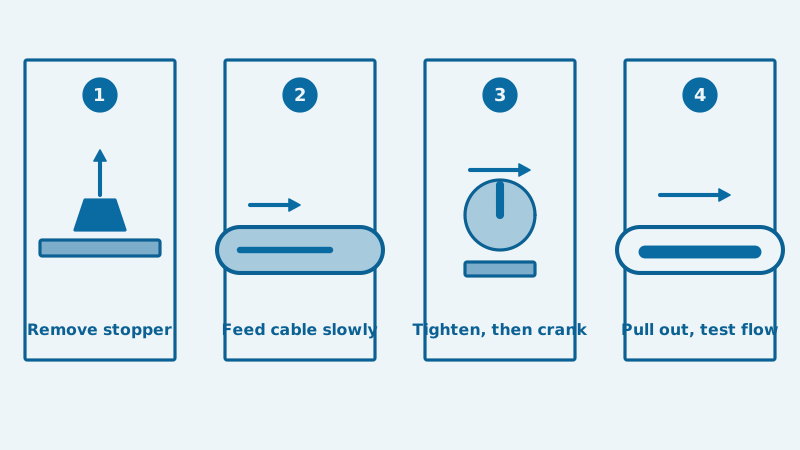
A drain snake is a flexible steel cable with a corkscrew or hook on the end. You feed it into the drain until it meets the blockage, turn it to hook or break the clog, then pull it back out. It works well on hair, soap and paper close to the drain, and poorly on roots, grease coating a long run or a collapsed pipe. This page follows the drain snaking hub and focuses on technique and what to do when it fails.
How does snaking a drain work?
The cable's head spins as you turn the handle or run the motor. At a clog it either bores through, or catches hair and debris and drags it back. A hand auger reaches about 25 feet, which covers most sink and tub branches. The cable does not clean the pipe wall, so a drain can run again and still be coated.
Wikipedia calls the tool a plumber's snake or drain auger, and describes hand cranked and powered types. For a toilet, a closet auger has a shorter shaft and a protective sleeve so it does not scratch porcelain. Larger drum machines, often called rooter machines, run on a motor and are used on main lines.
A fixture auger is a decent tool for a home toolbox. A basic drum auger costs about $10 to $30, according to published price guides.
How do I snake a drain step by step?
Remove the stopper or strainer, insert the snake until it stops, tighten the setscrew, and crank clockwise while pushing gently. When the cable breaks through or snags, work it back and forth, then pull it out slowly and clean it. Run hot water to test the flow. Do it slowly. Force is how pipes and traps get damaged.
Tips that matter:
- Wear gloves and eye protection. Whatever comes out will not be pleasant.
- Lay old towels around the opening and keep a bucket handy.
- Feed the cable in an inch or two at a time. If it tightens, back off a half turn and try again.
- Keep the cable straight where you can. Kinks in the coil weaken it.
- Do not use a power drill on a hand auger. It can whip the cable and twist it back into your hand.
- Pull the cable back slowly, because the clog is often on the head, and a fast pull drops it in the trap.
If the trap is easy to reach, taking it off is sometimes quicker. Our guide to cleaning a drain trap walks through it, and snaking a sink drain and snaking a bathtub drain cover the fixture by fixture detail.
What if snaking a drain did not work?
If the water still will not drain, the clog may be deeper than the cable reached, the cable may have bored a hole and left the rest, or the blockage may not be the kind a cable can move. Roots, collapsed pipe and grease coating the wall are the usual reasons. A second try with the same method rarely does better.
Think about what you pulled out. Hair and soap suggest you cleared part of it and more remains. A clean cable that never snagged suggests the problem is beyond its length, or that the pipe is damaged. Roots or a rusty film on the head suggest a main line problem.
Next steps in order: check the trap and the vent, try a plunger on the plugged fixture, and look at other drains. If more than one is slow, the issue sits in the shared line. Our page on why a drain is still clogged after snaking goes through the checks, and a tub that will not drain after snaking covers the common tub cause.
Why does the snake keep getting stuck or the drain keep clogging again?
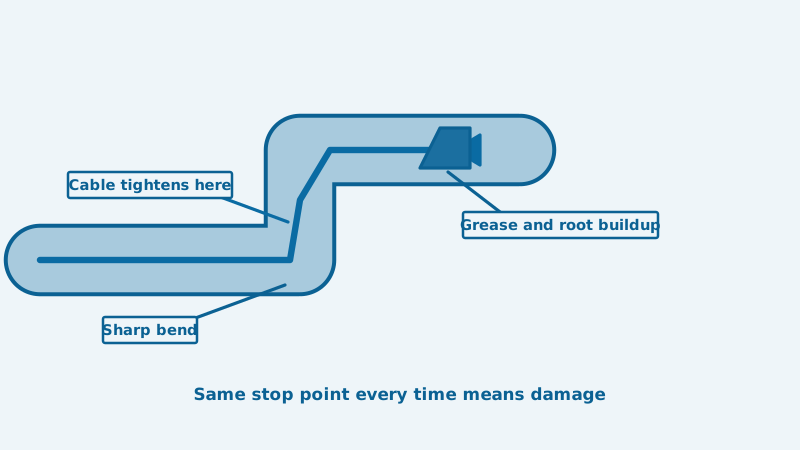
A snake sticks at bends, at the cleanout, at a joint or at a collapsed section, and it can catch on roots. If it stops at the same point every time, the pipe is likely damaged or offset there. A drain that clogs again within weeks suggests a coated or narrowed pipe, which a cable does not fix.
Older Los Angeles homes often have cast iron or clay lines, which scale and take roots. LA Sanitation says owners maintain and repair the whole private lateral, even when the roots come from a public tree. A camera shows what the cable cannot.
If the clog returns, consider a different method. Hydro jetting versus snaking explains why a jetter cleans the wall where a cable only opens a hole.
When should I stop and hire someone?
Stop when the cable will not pass, when more than one drain is affected, when water backs up in the lowest fixture, or when you have tried twice. A power machine in untrained hands can stick in a pipe or break a trap. A visit costs less than a pipe repair, and the result comes with a camera look.
You can request one on our quote page. We arrange a local drain cleaner who gives a written quote before work starts. Nothing is done until you agree.
What does it cost to have a pro snake a drain?
National guides put a plumber's snaking of a single sink, tub, shower or toilet at roughly $100 to $300, with an average around $220 to $250. A main line runs about $150 to $500, and tougher jobs go higher. West Coast costs are often 20 to 40 percent above the national numbers. The written quote after a visit is the real price.
Price depends on the fixture, how far the clog is, whether the trap must be pulled and the time of day. See drain snaking cost for a fuller breakdown. If you see a price that seems far above these ranges, ask what is included and whether a camera is part of it.
Return to the LA Drain Works home page for the other services.
Questions people ask
Can a drain snake damage pipes?
Yes, if forced. A cable can scratch the inside of a pipe, break a brittle trap or catch in a joint. Feed it slowly, back off when it tightens and never force it. Use a closet auger in a toilet. If the snake keeps stopping at the same spot, call someone.
How far can a hand snake reach?
Most hand augers are 15 to 25 feet, which covers a sink or tub branch. A main line is longer, and the cleanout may be farther than a hand snake reaches. A drum machine goes farther. If the clog is beyond the cable's length, it needs a bigger machine.
Is it better to snake from the trap or the drain opening?
If the trap comes off easily, snaking from the wall opening avoids the sharp bends in the trap. If not, go in through the drain or strainer. Whichever route you pick, use a bucket and towels, and put the trap back with the washers seated.
Why is my drain slow after snaking?
The cable probably opened a hole through the clog without cleaning the walls. Water runs through, but the remaining sludge narrows the pipe. Hot water and soap may help, and a jetter or a second pass may be needed. Slow drains at several fixtures point to the shared line.
Should I snake a toilet?
Use a closet auger, not a drain snake, and only after a plunger fails. A regular cable can scratch the bowl. If the toilet clogs again, or other drains gurgle when it flushes, the cause is deeper, and a closet auger will not reach it.
Sources used
- Wikipedia, plumber's snake
- HomeGuide, cost to unclog or snake a drain (2026)
- LA Sanitation, managing and protecting LA's underground sewer system
- Published 2026 price guides for drain snaking, checked November 2026
Page updated