Norwalk is one of the most house-heavy cities we cover: of 27,704 homes, about 73 in 100 are standalone houses, and the typical build year is 1957. The city is more specific than most about what a homeowner must do with the pipe between the house and the street. The areas page compares it with the cities around it. This page starts with that pipe.
What does Norwalk ask owners to do about the house lateral?
The city's Private Sewer Lateral page says owners must keep the lateral free of blockages, meaning clear of roots, grease and debris, and watertight, so stormwater does not leak in. A lateral is the pipe connecting your plumbing to the city main. The owner is responsible for it, including the part in the public right-of-way.
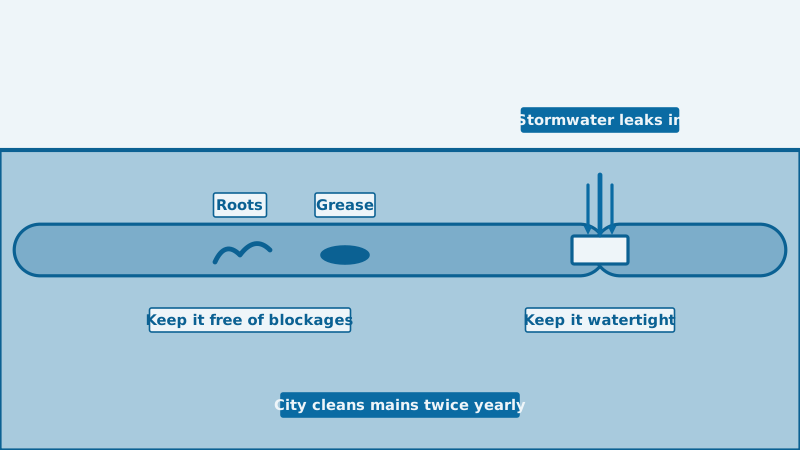
Norwalk does not clean laterals. It cleans its own mains, working with a private contractor to do it across the whole city twice a year, which the city page describes as biannual cleaning of its 160-plus miles of sewer line. That schedule keeps the main moving but does nothing for the pipe under your lawn. If your own line is slow, a clear main can still back up your tub.
When does Norwalk recommend a camera inspection?
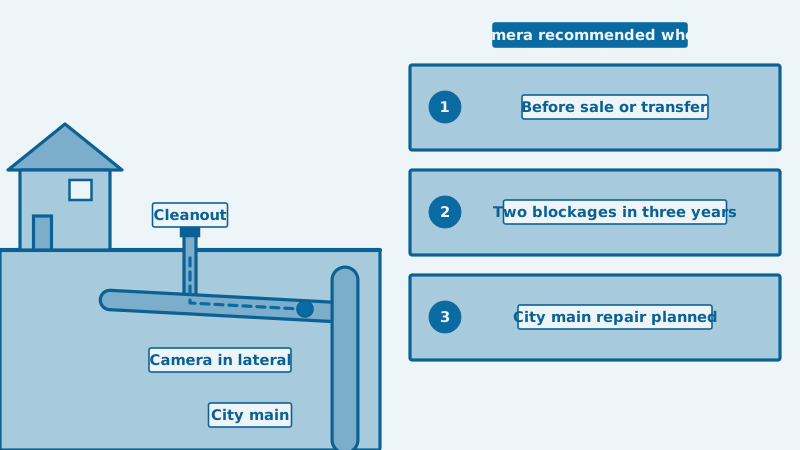
The city names four situations. First, before a property is sold or transferred. Second, when the property's use changes in a way that increases the sewer load. Third, when the lateral has had more than one blockage within three years. Fourth, when the city plans to repair or replace the main it connects to, in which case your lateral must be inspected and possibly repaired.
These are recommendations on the city's page, not a fee schedule. They are a decent guide anyway. Two blockages in three years means something is holding debris or letting roots in. A sale is the moment to find out what you are handing over. Our pages on sewer lateral inspection and the scope inspection before buying explain what the footage shows and what to ask for.
What state is a 1957 Norwalk lateral likely to be in?
The census profile puts about 62 in 100 Norwalk homes at 1959 or older, and only about a third of households rent, so most lateral problems land on the person who lives there. The era matters: houses from the 1950s were commonly joined to the street with vitrified clay, in small lengths with a joint every few feet.
I think the joints, not the clay itself, are where Norwalk's repeat clogs begin. Clay does not rust or dissolve, but joints shift over decades and a hairline gap is enough for fine roots to enter. Some homes may have had a section replaced with plastic. A camera tells you which. If it shows roots, read how to get rid of roots in a sewer line and the cost of root removal before agreeing to a quote.
Repairing a failed section of clay does not always need a trench. For the options, see pipe lining versus replacement.
Which trees can Norwalk residents plant or remove on the street?
Not many, and not on their own. Norwalk's code, Chapter 12.32, covers trees and shrubs on city streets. It bans poplar, willow, cottonwood, ailanthus and a few other species from the street, so ask the city before planting or removing anything in the parkway.
For drains, the practical rule is to leave a parkway tree alone and let the city deal with it. If your camera footage shows roots entering the lateral from a tree in the parkway strip, send the footage to Public Services. For roots from a tree in your own yard, our guide on preventing tree roots in a sewer line lists what to plant and where.
Is Norwalk's water hard, and does it matter for drains?
Yes, it is hard. The city's 2024 consumer confidence report says it pumps deep local wells and also uses Metropolitan Water District surface water. Groundwater hardness averaged 210.8 milligrams per liter with a range of 120 to 470. The Metropolitan surface water averaged 271 and ranged from 235 to 305.
By the usual scale, both are hard. Parts of Norwalk are served by other water companies, and their numbers differ, so check your own bill for the supplier. Hardness leaves scale on fixtures and soap film in traps, which makes a bathroom sink in Norwalk slow earlier than the same sink on soft water. It rarely causes a main line backup by itself.
What should you do when a drain backs up in Norwalk?
Call Public Services on (562) 929-5511 or file a work order on the city's website if you suspect the main. After hours, the city lists the Norwalk Sheriff's Department at (562) 863-8711. The page also describes 24-hour emergency response for sewer issues.
If the cleanout in your yard shows standing sewage, the main may be involved. If it is dry, the blockage is probably between the house and the cleanout. We'll arrange a local plumber to clear it, and you request a quote on our price request page. Stop running water, keep children and pets away from overflow, and read about emergency sewer drain cleaning. The full list of services is on the home page.
How much does it cost to clear a drain in Norwalk?
We have no Norwalk-only price survey. Los Angeles area ranges are $100 to $300 for a single fixture and $200 to $600 for a main line clog. Roots and hydro jetting raise it. Our main sewer line clog cost page lists every line of the bill.
Questions people ask
Who is responsible for the sewer lateral in Norwalk?
The property owner. Norwalk's own page says owners maintain and repair the house lateral, including the section in the public right-of-way. The city handles the public main, which it cleans twice a year. If a camera shows the blockage is in the main, report it to Public Services.
When should I get my Norwalk sewer lateral inspected?
The city recommends a camera inspection before a sale or transfer, when the property's use changes in a way that increases sewer load, after more than one blockage in three years, and when the city repairs the main your lateral connects to. These are recommendations. A camera costs far less than discovering a failed lateral after a closing.
Does Norwalk clean private sewer lines?
No. The city cleans its own mains twice a year with a private contractor, but laterals are the owner's. A homeowner arranges a plumber for the lateral. Ask for camera footage afterward, because it shows what caused the clog.
Can I remove a parkway tree in Norwalk?
Not on your own. Street trees fall under Chapter 12.32 of the city code, so ask the city before touching one. If roots from a parkway tree are in your lateral, document it with footage and report it to the city.
Sources used
Page updated