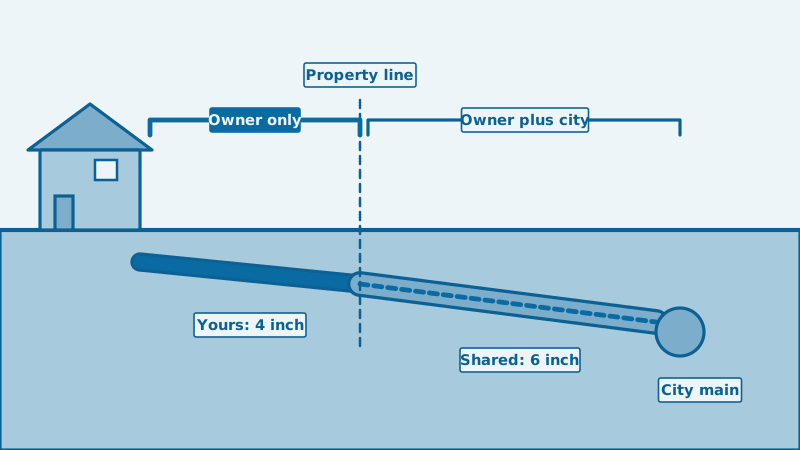
Most drain advice assumes the pipe is yours up to the street. Long Beach does not work that way. If you live here, read this before you call anyone about a backup. This page is part of our areas we cover section, and it is about one thing: the pipe under your lot and what the city says about it.
Who owns which part of a Long Beach sewer lateral?
Long Beach Utilities divides the lateral in two. The first section runs from the building to the sidewalk or property line, typically 4 inch pipe, and is yours. The second runs from the property line to the middle of the street or alley, typically 6 inch pipe, and is shared between you and the city. The city's own page still says you handle routine maintenance of both sections.
That wording matters in practice. A blockage under the parkway strip is not automatically the city's problem, and the sewer main itself is. Long Beach Utilities maintains the main, but as we read the city's page, an owner can be held responsible for repairs if what they put down the drain damages or clogs it, with fats, oils and grease as the example.
So the first useful question on any call is where the blockage sits. A camera run answers it. Our sewer camera inspection page explains what the footage shows and why the city asks for it before it will look at a problem on its side.
What is a cross bore, and why does Long Beach warn about it before drain cleaning?
A cross bore happens when a gas line was drilled through a sewer pipe, usually by trenchless installation. If someone then runs a root cutter or cable through the lateral, the blade can break the gas line. Long Beach Utilities tells residents to get an inspection that rules this out before any clearing starts.
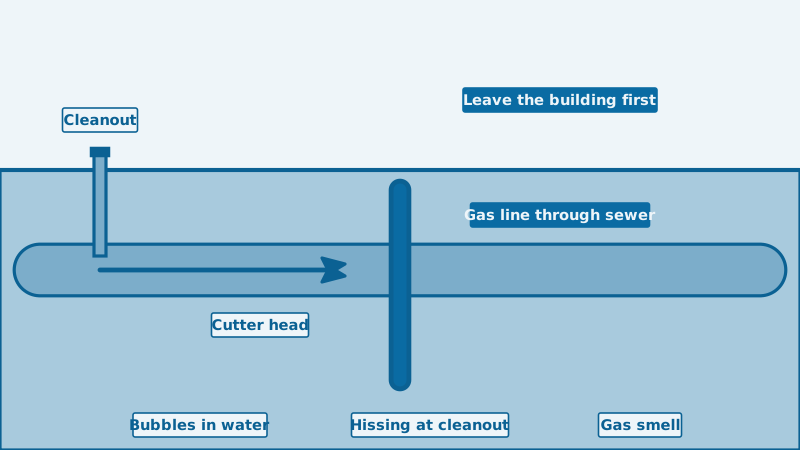
The city lists three warning signs. Look for bubbles rising through standing water or in the toilet bowl. Listen for hissing, whistling or roaring at the cleanout, the vents or inside the house. Smell for natural gas near the cleanout or vents. If you notice any of these, leave the building and call the gas emergency number the city lists, (562) 570-2140, before you touch the drain.
We would rather camera a Long Beach lateral first than cut blind. If you want to understand how cameras and jets differ here, hydro jetting versus snaking covers the two tools.
Does my Long Beach home need a cleanout, and how big?
Yes, if you want the city to treat your lateral as serviceable. Long Beach Utilities strongly recommends a 4 inch cleanout that sits above ground, away from the building, on the downstream side so the lateral no longer runs under the structure. The city cites its Policy Section 1406 for this.
Many older houses have no usable cleanout at all, or the only access is a vent stack on the roof or a fixture inside the house. That turns a ten minute job into a much harder one. If your lot has no cleanout, installing one is usually the best first repair, and our page on cleaning a sewer cleanout explains what a good one looks like.
Ready to see what is going on in your pipe? Ask for a written quote and we will arrange a visit with a local plumber.
What do Long Beach homes and streets look like underground?
Long Beach is the largest city among the ones we cover, with 181,477 homes in the Census profile, and about 52 in 100 of them were built in 1959 or earlier. A house from that era usually has a clay lateral or a cast iron one, because plastic pipe was not common in home construction until later.
The city grew in pieces. According to Wikipedia, Belmont Heights, Belmont Shore and Naples were laid out by the Alamitos Land Company, while Bixby Knolls, California Heights, Los Cerritos and North Long Beach come from the 1916 subdivision of Rancho Los Cerritos. Each of those districts was built at a different time, so two neighbors a few miles apart can have laterals of very different ages.
Long Beach also sits over an oil field: according to Wikipedia, the Wilmington Oil Field lies partly under the city. We cannot tell you what that means for your own street, but a belly or offset in an old clay pipe is one of the first things a camera looks for. Our page on old clay sewer pipe lists how it fails.
How hard is Long Beach tap water, and does it matter for drains?
It depends on which water zone you live in. The 2025 Long Beach Utilities report lists a blended zone, which serves most of the service area, averaging 76 ppm hardness (about 4.4 grains per gallon). The MWD zone averages 220 ppm (about 12.8 grains), with a maximum of 300 ppm.
Seventy one percent of the city's water in 2025 came from local groundwater in the Central Basin and 29 percent was imported from the Metropolitan Water District. Hardness matters for drains mostly through scale: harder water leaves more mineral crust in small fixture drains and on old iron pipe. The blended zone is soft enough that it is rarely the cause of a slow line. If you are in the MWD zone, scale becomes a more realistic suspect.
When does Long Beach rain turn into drain trouble?
Long Beach is dry for most of the year, and the rain that does fall arrives mostly in winter. That pattern means roots work all summer and the symptoms show up when the first heavy storm raises groundwater and flows.
If your drains gurgle during or just after a storm, we suspect groundwater getting into a cracked lateral or a root mass catching more debris. Call it a seasonal pattern, not a coincidence. Our page on gurgling drains walks through the causes.
How do you book drain cleaning in Long Beach?
Send a quote request with your address, what is draining badly and whether you have seen anything come up through a floor drain. We will arrange a visit from a local plumber, and you get a written quote before work starts. Say whether you have a cleanout, whether a gas line has ever been bored near the house, and whether neighbors have had backups.
For a backup happening right now, Long Beach Utilities lists (562) 570-2390 for sewer emergencies and after hours dispatch. Call it if the overflow is coming from a manhole or the street. You can also check our home page for the full list of what we arrange.
Questions people ask
How much does drain cleaning cost in Long Beach?
A lateral with an easy cleanout costs far less to clear than one with no access and a gas line nearby, so the line decides the price here, not the zip code. The drain cleaning cost guide has typical ranges. Our quote comes in writing first.
Who pays if the clog is under the street?
If the blockage is in the shared section or the city main, Long Beach Utilities investigates, but only after you have done the first inspection, clearing and draining of your own lateral. Send video showing a problem on city property to the Manager of Sewer Operations, whose address and phone are on the city's sewer backups page.
Can I snake my own Long Beach lateral?
The city says a homeowner or a private plumber can snake or hydro jet a lateral when there is no cross bore and the blockage is on your side. Rule out the gas risk first, because a cutter can damage a gas line. Never push a cutter into a lateral if you smell gas.
Are there council rules for drain cleaning in Long Beach?
The rules sit in the Long Beach Utilities policy. The 4 inch cleanout standard is in Section 1406, and installing a new sewer connection goes through Development Services. Ask Development Services whether a permit applies before any repair or replacement that involves digging.
Sources used
- Long Beach Utilities, sewer laterals and mains
- Long Beach Utilities, sewer backups, cross bore warning and cleanout policy
- Long Beach Utilities, 2025 Water Quality Report (hardness by zone, groundwater share)
- US Census Bureau profile of Long Beach, via Census Reporter
- Long Beach, California (geography and neighborhoods)
Page updated